Neoclassical Economics

Think further >> Teaching materials >> Economic approaches >> Neoclassical economics

Why study Neoclassical Economics?

Neoclassical economics looks at the world through a deceptively simple prism: that of scarcity, prices and markets. It shows how prices contain information about what goods are desired and what goods are scarce. Thus, through the price level entrepreneurs are informed what they should produce. It is often attacked for its strong and unrealistic assumptions, like fully rational human people with no social ties, the assumed existence of markets without (violent) conflict or power struggles, and the omission of social or ecological factors from its basic framework. But it provides a simple and powerful analysis worth diving into!

Where to start?

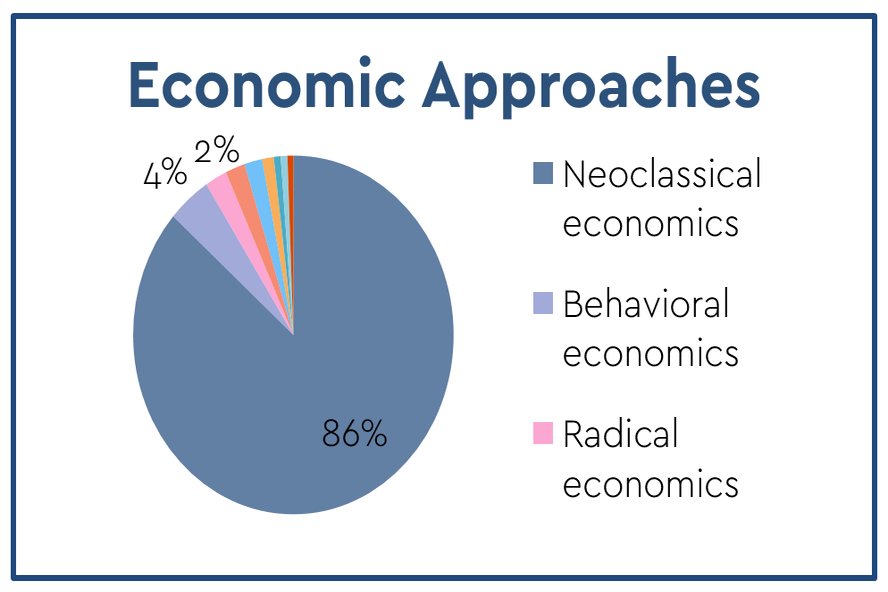
Buy any textbook about economics and the chance is 90% that you'll be holding a largely neoclassical work. For a critical view on the approach, start with Dani Rodrik's Economics Rules, or The Death of Neoclassical Economics by David Colander. Exploring Economics provides a more extensive definition of the approach, including many useful sources, and What is Neoclassical Economics goes even deeper into defining the approach.

Speaker(s): Professor Dani Rodrik Chair: Professor Wouter Den Haan Recorded on 7 October 2015 at Old Theatre, Old Building Based on his new book, Economics Rules: The Rights and Wrongs of the Dismal Science, Professor Rodrik will give an accessible introduction to the strengths of the discipline of economics and why it is so often misunderstood, not least by its practitioners.
Professor Jean Tirole, chairman of the Jean-Jacques Laffont - Toulouse School of Economics Foundation and scientific director of the Institute for Industrial Economics, discusses his new book Economics for the Common Good on November 2, 2017, at the Peterson Institute for International Economics.
Alfred Marshall was one of the most important economists shaping the field as we practice it today. By synthesizing the classical economics focus on production and costs with the new marginal utility theory of value and the concept of subjective utility, Marshall created the neoclassical synthesis. He also formalized elasticity, the theory of the firm, and welfare analysis.
America's freedom and prosperity derive from the combination of the idea of human liberty in America's Declaration of Independence with the idea of economic freedom in Adam Smith's Wealth of Nations. Friedman explains how markets and voluntary exchange organize activity and enable people to improve their lives. He also explains the price system.
Many economic downturns throughout human history can be explained by real business cycle (RBC) theory. So what makes this theory "real" and what are its drawbacks? We'll cover both in this five-minute tour of RBC. ------------------------------------------------------------------------------------------------------------ Subscribe for new videos every Tuesday!
 

See more

Findings: Theoretical approaches

Materials: Critical thinking